
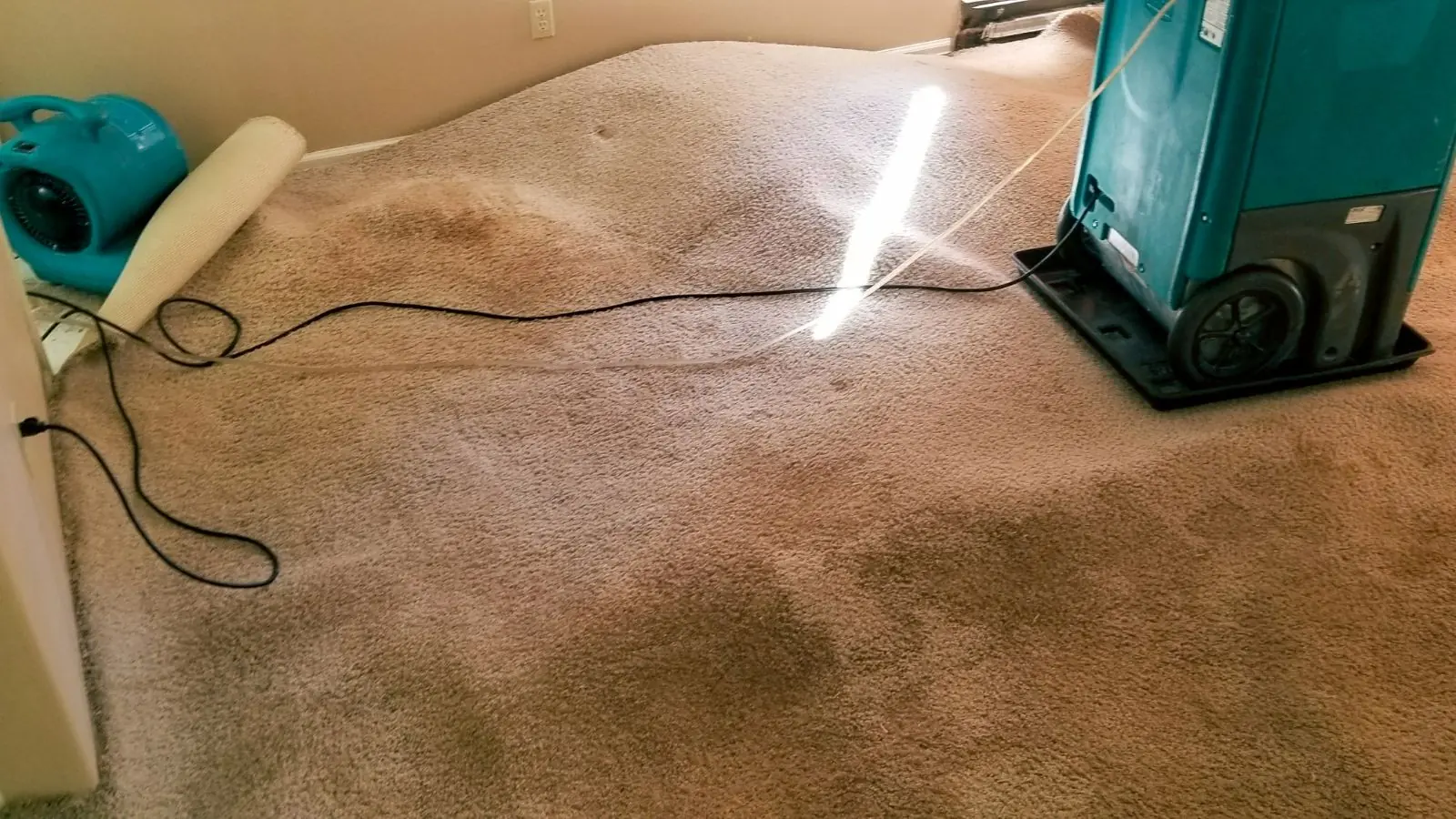
Carpet water damage restoration is the process of extracting water from carpet and pad, drying the subfloor beneath them and deciding whether the carpet can stay or must be replaced. The answer depends mostly on the water category and how long the carpet has been wet.
Carpet is a sponge on top of a sponge. The carpet fibers hold some water, the pad under them holds much more and the subfloor below holds the rest. A surface that feels only damp can be hiding a pad that is soaked through, which is why the check is done with a meter and not a hand.
Can the carpet be saved
The two facts that decide it are the source and the time.
- Clean water caught early: carpet and often the pad can be extracted and dried in place.
- Clean water left for days: the water has aged into Category 2, the pad is likely to be removed and mold becomes a concern.
- Category 2 or 3 water: the pad is removed, and carpet that was in Category 3 water is usually discarded.
- Sewage or flood water: carpet is discarded. See sewage backup cleanup.
How wet carpet is dried
- Extraction removes as much water as possible from the carpet and pad.
- The carpet is lifted and the pad is checked. In many losses the pad is removed even if the carpet stays.
- Air movers dry the underside of the carpet and the subfloor, while LGR dehumidifiers pull moisture out of the air.
- Moisture meters check the carpet, the pad area and the subfloor daily.
- When readings match the dry standard, the carpet is reinstalled or replaced.
Drying carpet in place needs a stretch and re-installation afterward. That is a step many people skip, and a loose carpet that ripples after drying usually needs to be stretched again.
Wet carpet on a concrete slab or upper floor
Carpet on concrete behaves differently than carpet over wood. A slab holds moisture and releases it slowly, so the underside of the carpet can stay damp for days. Carpet over a wood subfloor on an upper floor has another worry, which is that water travels down through the subfloor and into the ceiling below. For a wet ceiling below a wet floor, see ceiling water damage repair.
Many Linden homes are older. About 59 percent of housing units were built before 1960 according to the Census Bureau's 2013 to 2017 profile, and some carpet sits over original hardwood. If hardwood is under the carpet, the hardwood floor water damage page explains what is possible there.
Odor and mold
A musty smell in wet carpet usually means microbes are growing in the pad or the subfloor. Mold needs moisture, and the EPA advises drying water-damaged areas in the first 24 to 48 hours to prevent mold growth. Deodorizing does not remove mold. If a visible mold problem is present, the mold remediation page explains what that involves.
Carpet is wet right now?
Call the 24/7 line and describe the water and how long it has been there.
What drives the cost
Cost factors for carpet water damage
- Water category: determines whether the pad and carpet are kept.
- How long it was wet: older water means more removal.
- Area and number of rooms: more carpet means more extraction and drying.
- Pad and subfloor: removal and replacement, and drying the subfloor.
- Drying days: air movers and dehumidifiers run until readings are dry.
To get a real number, call (833) 521-1033 and describe the carpet.
Insurance note
Sudden and accidental water, like a burst pipe or appliance failure, is often covered by a homeowners policy, while slow leaks are often not. Ask your insurer. Keep a sample of the carpet and pad if asked, take photos and keep receipts.
What to do before help arrives
Lift furniture legs off wet carpet and remove loose items. Do not walk on soaked carpet more than needed, and do not use a household vacuum on standing water. Note what the water touched for your records.
Water damage work is guided by ANSI/IICRC S500, the published standard for professional water damage restoration.
Carpet water damage questions in Linden
How long can carpet stay wet before it needs to be replaced?
Clean water left for a day or two can often be dried, but after that the pad is usually removed and mold risk rises. Dirty water means replacement.
Can wet carpet be dried without lifting it?
Sometimes surface water can be extracted without lifting, but lifting is needed to dry the pad and subfloor.
Is it worth saving old carpet?
That depends on its condition and your plan. Replacing the pad is common even when the carpet stays.
Does it matter if the carpet is wall to wall or a room-size rug?
Yes. Loose rugs can be taken outside or to a drying space, while wall-to-wall carpet is dried in place or lifted. Describe which you have when you call.