
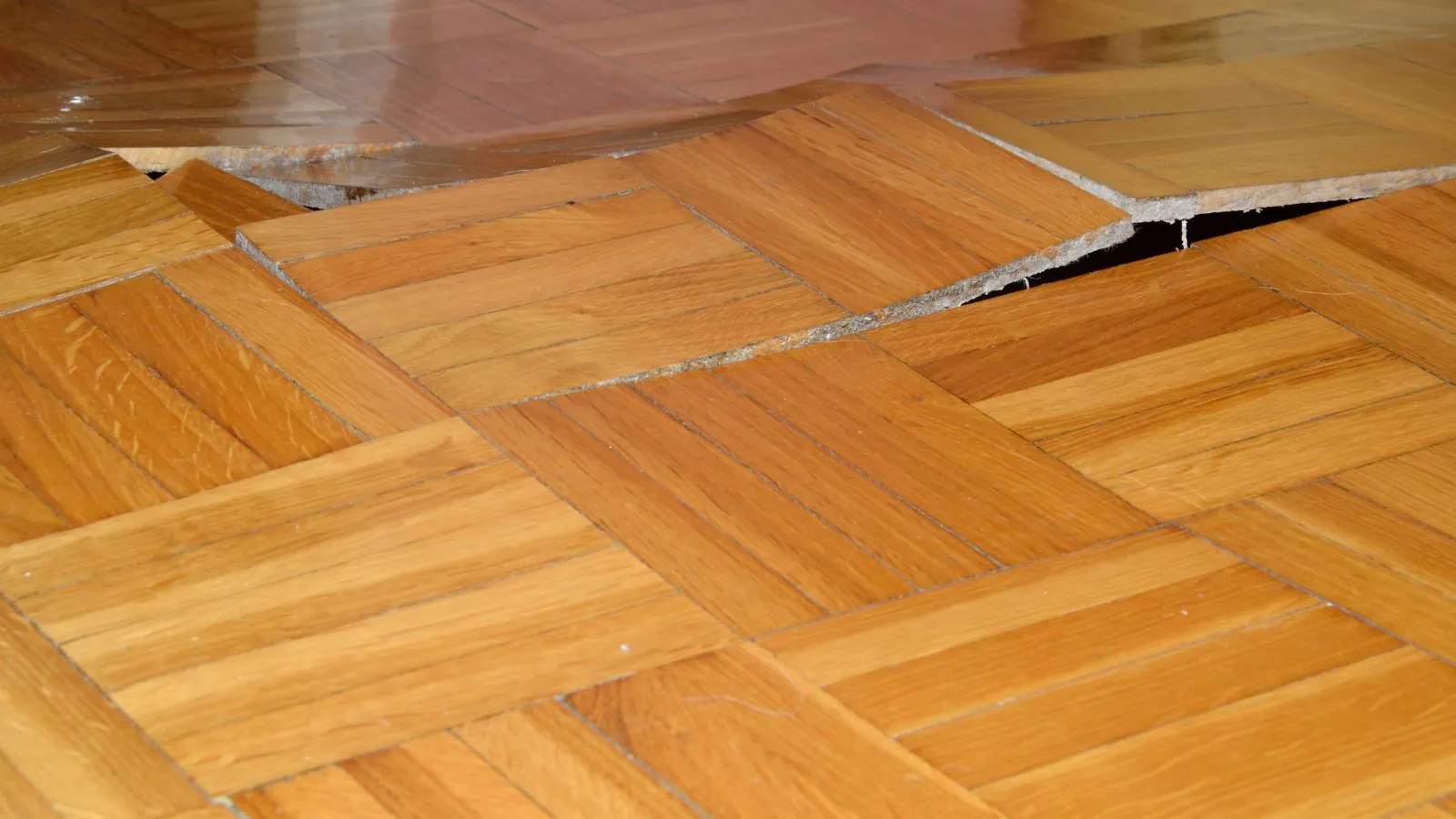
Hardwood floor water damage repair is the drying, assessment and repair of wood and laminate flooring after water has reached it from above or below. Wood absorbs water through its edges and underside, so the damage often shows days later as cupping, crowning or gaps. The earlier the water is removed and the floor is dried, the better the chance that the boards can be kept.
This page is about the floor surface. If the question is how the subfloor and walls are dried, that is structural drying. If the floor is covered in carpet, see carpet water damage.
What water does to wood floors
Wood is hygroscopic, which means it takes on moisture from its surroundings. A board that gets wet swells across its width, and because it is held by neighboring boards and fasteners, it pushes up or bows.
- Cupping: the edges rise higher than the center, usually because moisture came from below.
- Crowning: the center rises above the edges, which can appear when a cupped floor is sanded before it dried.
- Buckling: boards lift off the subfloor, a sign of heavy water.
- Staining and blackening: standing water or long exposure darkens the finish and the wood.
Which floors can be saved
The answer depends on the type of floor and the time.
| Floor type | How it responds | Typical outcome |
|---|---|---|
| Solid hardwood | Swells, cups, can often dry | Often saved if dried quickly |
| Engineered hardwood | Layers can separate | Mixed, depends on the core |
| Laminate | Swells at the edges and does not recover | Usually replaced |
| Hardwood over a slab | Moisture trapped beneath | Needs drying from below |
Floor drying systems use panels or mats that pull moisture from the board and subfloor without removing the whole floor. Small holes may be drilled in the subfloor or the boards. A thermal camera and moisture meter are used to track progress. When the floor has been wet for many days or has lifted off the subfloor, removing a section is often needed.
Do not sand too early
Sanding and refinishing a floor that is still wet seals in moisture and can cause the floor to crown or gap later. Moisture readings need to match the dry standard before any refinishing starts. A floor can feel dry on the surface while the wood below is not.
Water from above or below
Water from a pipe or appliance usually soaks the top first, so quick removal helps. Water from below, such as a basement leak or slab moisture, shows up as cupping with no visible spill.
In older Linden homes, original hardwood is often under carpet. About 59 percent of housing units in the city were built before 1960 according to the Census Bureau's 2013 to 2017 profile. If you see damage under a carpet, check the wood too.
For a pipe-related source in a wall, see burst pipe water damage, and for a failed appliance, appliance leak water damage.
Wood floor soaked?
Call the 24/7 line and describe the floor and how long it has been wet.
What drives the cost
Cost factors for hardwood floor water damage
- Floor type: solid, engineered or laminate.
- How long it was wet: longer exposure means more movement.
- Area affected: how many rooms and how much flooring.
- Drying method: floor drying systems add equipment days.
- Refinishing or replacement: sanding, staining and sealing or installing new flooring.
To get a real number, call (833) 521-1033 and describe the floor.
Insurance note
Sudden and accidental water damage is often covered, while slow leaks often are not. A claim for flooring may depend on matching the rest of the floor, so ask your insurer. Photograph the floor before work starts, and keep moisture readings.
What to do before help arrives
Wipe standing water off the boards, move rugs and furniture, and keep the room ventilated. Do not sand, seal or hammer cupped boards while they are wet. Photograph the floor before any work.
Water damage work is guided by ANSI/IICRC S500, the published standard for professional water damage restoration.
Hardwood floor water damage questions in Linden
Will my cupped floor flatten on its own?
Sometimes, if the moisture source is gone and the floor dries slowly, cupping eases. Wait for readings to match the dry standard before deciding.
Can a buckled floor be repaired?
Often some boards can be replaced, but heavy buckling usually means removal of the affected section.
How long does it take to dry a wood floor?
Often several days to a couple of weeks, depending on the wood, the water and the subfloor. Moisture readings decide.
Should I remove the boards myself?
Not usually. Removing boards without a plan can damage ones that could have dried in place.