
After a leak, the question everyone asks is when things will be dry. The answer is not a date. Drying is finished when moisture readings in the wet materials match readings in dry materials of the same type, and that can take a few days or longer. This guide explains what controls drying time, why some materials are slow and how to tell when the work is done.
The 24 to 48 hour window
The EPA says it is important to dry water-damaged areas and items within 24 to 48 hours to prevent mold growth. That is not the time it takes to dry. It is the window in which drying should begin and make real progress. After that window, materials that stay wet become more likely to grow mold, which is why the first day matters more than any later day.
What controls drying time
Five things decide how long drying takes.
- The material. Porous, thin materials such as carpet and drywall dry faster than dense ones such as hardwood, plaster and concrete.
- How much water. More water in more places takes longer to remove.
- Air conditions. Warm, moving, dry air dries faster than cold, still or humid air. Dehumidifiers and air movers control this.
- Access. Water trapped behind cabinets, under flooring or inside walls dries slowly unless it is reached.
- How fast it started. Early extraction cuts the total time.
| Material | How it dries | What affects it |
|---|---|---|
| Carpet | Dries relatively quickly on top | The pad and subfloor take longer |
| Carpet pad | Often removed instead of dried | Water category and time |
| Drywall | Dries in place if clean and caught early | Wetness, paper face, insulation behind |
| Insulation | Often removed | It holds water against framing |
| Hardwood floor | Slow, and may cup or buckle | Subfloor moisture, floor type |
| Plaster | Slow | Thickness and age |
| Concrete and block | Slow, releases moisture for days | Depth of water and ventilation |
| Wood framing | Moderate | How deeply it soaked |
These are general patterns, not promises. A particular job depends on the specifics.
What equipment does
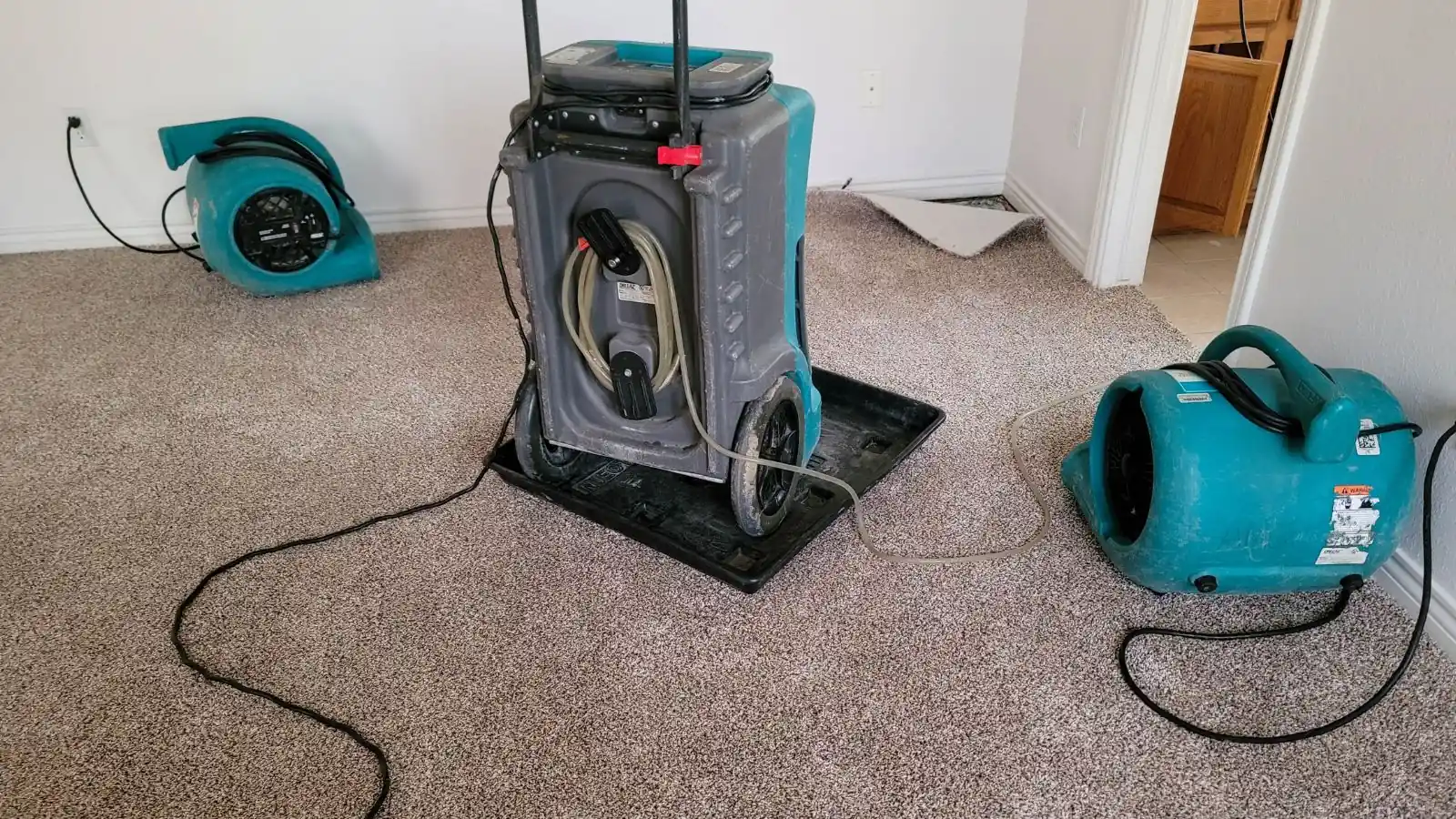
Air movers push dry air across wet surfaces, and LGR dehumidifiers remove moisture from the air so more can evaporate. In cold or very damp conditions desiccant units may be used. Hidden moisture in wall cavities can be dried through small openings with directed airflow. A restoration crew also checks conditions with a hygrometer and adjusts equipment.
How you know it is dry
A surface that feels dry is not proof. A moisture meter reading on the wet material and on unaffected material of the same type gives the comparison. The goal is a match. The crew records readings daily, and the log shows the trend downward. Equipment is removed when readings reach the goal, and a final check after equipment is off confirms the numbers hold.
Why it sometimes takes longer than expected
- A hidden source is still leaking.
- Materials absorbed more water than they looked like.
- Humid weather or a closed house slows evaporation.
- Wet insulation or padding was left in place.
- Equipment was removed too early.
If readings stall, the cause should be found, not ignored.
What you can do while equipment runs
Once air movers and dehumidifiers are running, keep doors and windows closed in the drying area unless the technician says otherwise. Do not turn the equipment off or move it, since it was placed to follow the moisture. Keep pets and children away from cords and hot exhaust, and leave the readings to the daily visits.
Drying in Linden buildings
Linden has many buildings that share walls, floors and stacks. According to the Census Bureau's 2013 to 2017 profile, about 28 percent of housing units are in two-unit buildings and about 23 percent are in buildings with three or more units.
In those buildings, drying often involves more than one unit, shared walls and ceilings and the cooperation of neighbors and the property manager. Equipment needs power and access to each affected space, so arranging that early shortens the job. After a storm or flood, power may also be out, and a restoration company can plan around that.
What you can do while it dries
Keep doors and windows closed so equipment can work, avoid turning equipment off, and leave air movers where they are placed. Do not paint, carpet or refinish until readings are dry. Tell the crew about anything that smells musty or feels damp. See the structural drying page for the process, and hardwood floor water damage for the slow-drying surface most homes have.
Whether you are in Linden, Roselle Park or Elizabeth, the principles are the same.
What to do before help arrives
Remove wet rugs and loose items, keep equipment running and keep cords out of damp areas. Do not seal wet materials behind paint or flooring.
Drying time questions in Linden
How many days does a typical drying job take?
Often several days. It can be shorter for a small clean-water loss and longer for deep or dense materials. Moisture readings decide.
Can I stop the equipment early to save on noise?
It is better not to. Equipment removed early can leave moisture behind that causes odor or mold.
Why does my floor feel dry but the crew keeps drying?
The surface dries first. The subfloor, pad or wall cavity may still be wet.
Does a house dry on its own?
Slowly, if the weather helps. But the EPA window for preventing mold is short, so active drying is usually needed.