
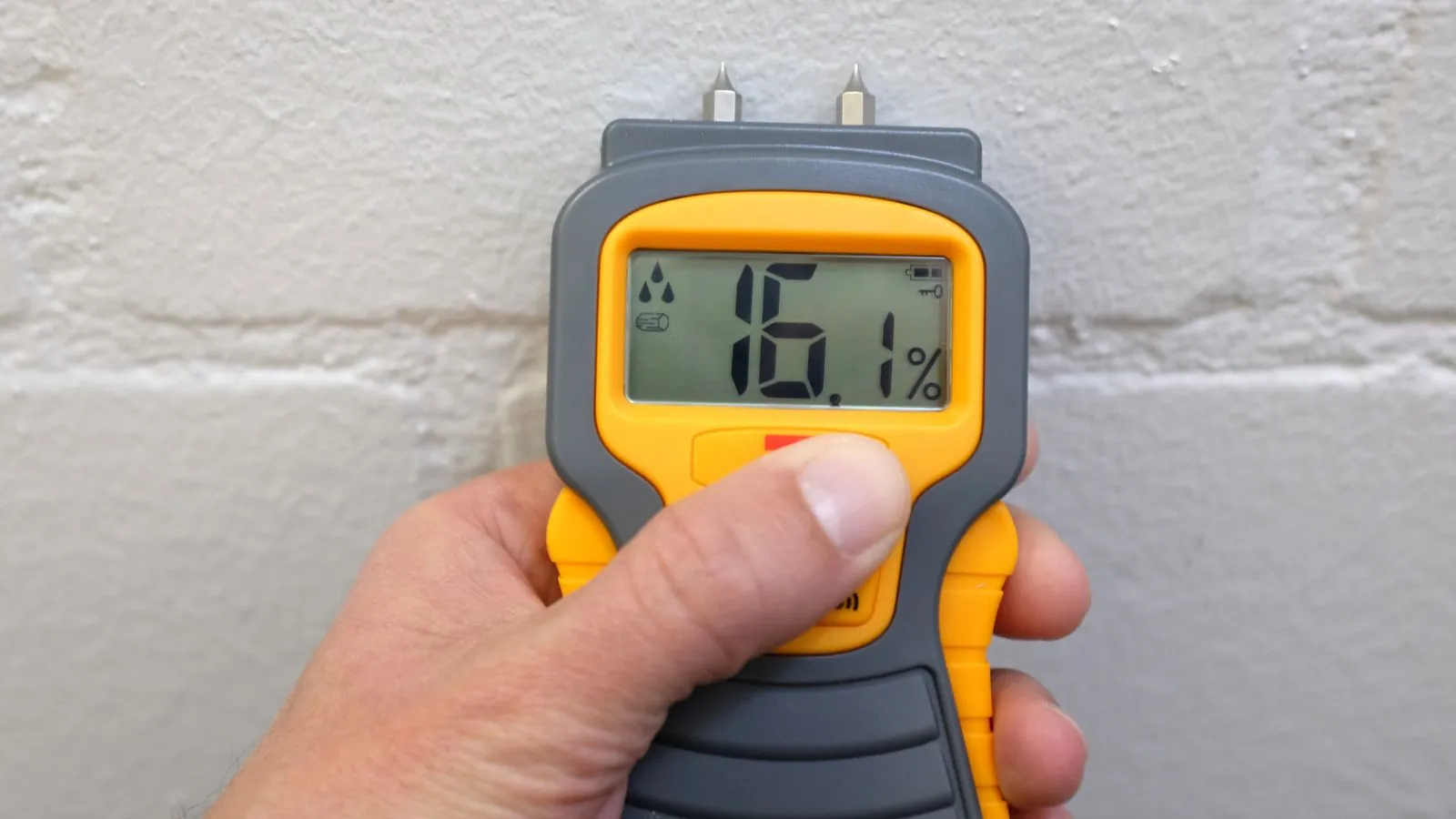
After a leak, the question is whether the wall, floor or ceiling is actually dry. Surfaces lie. Paint can look fine over wet drywall, and a floor can feel dry over a wet subfloor. A moisture meter gives a number, and when it is used with a reference, that number tells you something. This guide explains how meters work, what the readings mean and where homeowners go wrong.
Types of meters
- Pin-type meters have two probes pushed into the material. They measure electrical resistance, which falls as moisture rises. They are good for wood and drywall where you can make small marks.
- Pinless meters use a flat sensor pressed against a surface and read through it to a shallow depth. They scan large areas quickly without damage.
- Thermal imaging cameras show surface temperature differences. Wet areas often look cooler, because water evaporates. A camera does not measure moisture, it points to where to measure.
- Hygrometers measure air temperature and humidity, which tells you whether drying conditions are working.
What the numbers mean
Meters read in different scales. Wood is often read as a percentage of moisture content, while drywall and other materials may use a relative scale. That means a reading is only meaningful if you know the scale and the material.
The most important number is not the reading itself but the comparison. A restoration professional takes readings on a wet area and on an unaffected area of the same material, and the dry reading becomes the drying goal. This is the approach used in the industry standard ANSI/IICRC S500.
| Tool | What it tells you | Limit |
|---|---|---|
| Pin-type meter | Moisture in wood and drywall at the pin depth | Makes small holes, reads one spot |
| Pinless meter | Moisture near a surface across an area | Shallow reading, can be fooled by metal |
| Thermal camera | Cool spots that suggest moisture | Does not measure moisture |
| Hygrometer | Air humidity and temperature | Does not measure materials |
Common mistakes
- Reading only the surface. Drywall can be dry on the face and wet in the cavity or the paper back.
- Ignoring the material. A reading that is normal for one material can be wet for another.
- No reference reading. Without a dry comparison, a number means little.
- Stopping too early. A single dry reading right after equipment runs can be misleading. Materials release moisture back after equipment is removed, so a final check after a rest period matters.
- Metal and foil. Pinless meters can give false readings near pipes, nails and foil-backed insulation.
Moisture and old Linden homes
About 59 percent of Linden housing units were built before 1960 according to the Census Bureau's 2013 to 2017 profile. Older homes often have plaster over lath, masonry walls and old wood floors, and these materials read and dry differently from modern drywall.
Plaster can hold water for a long time and a pin meter reading in it may need a professional's judgment. If your home is old, readings are better taken by someone who knows what the material should read when dry.
Linden moisture notes
Moisture in a Linden basement can come from several places. The county hazard mitigation plan notes that high tide arriving with heavy rain causes backflooding in low-lying areas and that storm drains in some areas back up when tree roots restrict sewer lines.
Both leave moisture in block walls and concrete floors that dries slowly. A single reading after a few days may look dry while the slab still holds water, so repeat readings across several days tell a more honest story than one visit.
Using readings to decide
A restoration crew uses readings to decide where to place air movers and dehumidifiers, to find hidden wet areas and to decide when to remove equipment. As a homeowner, you can use the log to check that the work is progressing. Ask for the moisture map at the start and daily readings after that. Daily readings should trend downward, and they should end at or near your reference.
If readings stall, ask why. The cause may be a hidden source still leaking, a slab that needs more time or equipment that needs to be moved.
When to bring in help
If water has been in a wall or floor for more than a day or two, the EPA advises drying water-damaged areas in the first 24 to 48 hours to prevent mold growth, so an early reading matters.
Hardware store meters can help for a first look, but they do not replace a mapped and logged drying job. See the structural drying page for what that involves and wall and drywall water damage for how wall readings lead to repair.
The same approach applies in neighboring Roselle Park and Elizabeth, where homes and buildings range widely in age and construction.
What to do before help arrives
Check readings in several spots and write them down with the date. Do not push a pin meter into a wall near wiring. Do not assume a dry surface means a dry wall.
Moisture meter questions in Linden
Can a cheap moisture meter tell me if my wall is dry?
It can give a rough idea, but only with a dry reference and knowledge of the material. Professional meters and thermal cameras are more reliable.
What reading is dry for drywall in a Linden home?
It depends on the meter's scale. Compare with a dry wall of the same type in the same house, and ask your restoration company for the dry goal.
Why did my wall read wet again after the fans were removed?
Moisture can move out of deeper layers after equipment stops. This is why a final check is useful.
Does a thermal camera replace a moisture meter?
No. A camera shows where to look, and a meter confirms moisture.